



Every successful business starts with an idea, but not every idea becomes a successful business. In fact, most business ideas fail not because they are bad, but because they are never properly tested in the real market. Many founders invest time, money, and energy into building products that nobody actually wants. This is where market validation becomes critical.
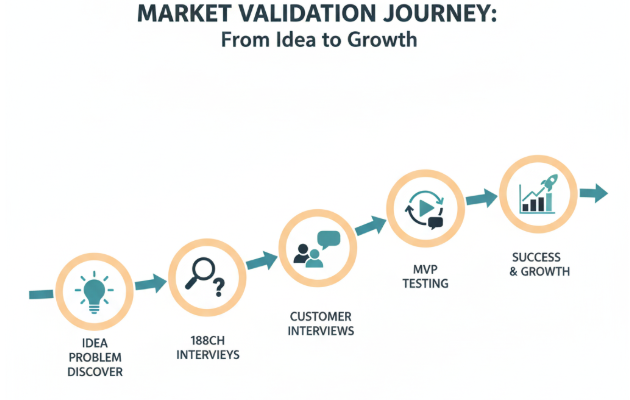
Market validation is the process of proving that your idea solves a real problem for real people who are willing to pay for it. It helps you move from assumptions to evidence. Instead of guessing whether your idea will work, you use data, feedback, and real-world behavior to confirm demand before you fully commit. This article explains market validation step by step in simple language so anyone, even without a business background, can understand and apply it.
What Is Market Validation?
Market validation is the process of checking whether your business idea has real demand in the market. It answers one simple but powerful question: Do people actually want this? It goes beyond personal belief, passion, or excitement. Many entrepreneurs fall in love with their ideas, but the market does not care about emotions. The market responds only to value.
Validation means testing your assumptions about customers, problems, and solutions before building a full product or business. It helps you understand whether people face the problem you want to solve, how they are solving it today, and whether your solution is something they would choose and pay for.
Market validation is not about perfection. It is about learning quickly and cheaply. Even if your idea is not perfect at first, validation helps you improve it in the right direction instead of guessing blindly.
Why Market Validation Matters Before You Build
Building a business without market validation is like constructing a house without checking the land first. You may invest months or years only to discover that the foundation is weak. Many startups fail because they build products based on assumptions rather than customer needs.
Validation matters because it saves time, money, and effort. It reduces risk by giving you evidence before you scale. When you validate early, you avoid wasting resources on features people do not care about. You also gain confidence when moving forward because your decisions are based on real feedback, not hope.
Investors, partners, and even early customers trust validated ideas more. When you can show that people are interested, engaged, or already paying, your idea becomes much stronger. Market validation turns uncertainty into clarity.
Ideas vs Execution: Why Validation Is the Real Test
Ideas alone have little value. Execution is what turns ideas into results, and validation is what guides execution in the right direction. Two people can have the same idea, but the one who validates, listens, and adapts usually wins.
Many founders believe that secrecy protects ideas. In reality, ideas grow stronger when tested openly. Validation forces you to face reality early. It shows you what works, what does not, and what needs to change. This process shapes better execution.
A good idea without validation is just a guess. A validated idea becomes a roadmap for execution.
Step 1: Define Your Idea, Assumptions and Hypotheses
Every business idea is built on assumptions. You assume who your customer is, what problem they have, and how your solution helps them. The first step in market validation is writing these assumptions down clearly.
You should define what you believe about your customer’s problem, your solution, pricing, and delivery. These beliefs are called hypotheses. Validation is the process of testing whether these hypotheses are true or false.
This step brings clarity. Instead of vague thinking, you create a clear structure for learning.
Clarifying the Problem You Are Solving
A strong business starts with a strong problem. Many founders focus too much on solutions and not enough on problems. Market validation begins by understanding whether the problem is real, frequent, and painful enough to solve.
A good problem causes frustration, costs time or money, or creates emotional stress. If people are actively looking for solutions or creating workarounds, the problem is worth validating further.
Identifying Your Target Customer
Your product is not for everyone. Trying to target everyone usually means helping no one. Validation requires identifying a specific group of people who share the same problem.
Your target customer might be defined by profession, age, industry, lifestyle, or situation. The clearer your target customer is, the easier it becomes to validate demand.
Step 2: Research the Market Size and Opportunity
Market validation also involves understanding the size of the opportunity. A great solution in a tiny or shrinking market may not be sustainable. Market research helps you estimate whether enough people face the problem to support a business.
You do not need complex calculations at this stage. You need realistic understanding. Even a small market can be valuable if it is focused and underserved.
Understanding Market Demand and Trends
Markets change over time. Some grow, some shrink, and some evolve. Validation includes understanding whether your market is expanding, stable, or declining. Timing plays a big role in success.
If a problem is becoming more common or urgent, the opportunity is stronger. If technology or behavior is shifting, it may create new demand.
Step 3: Validate Demand Through Search and Online Behavior
Before talking to customers directly, you can learn a lot from how people behave online. Search engines, forums, and social platforms show what people are actively looking for.
When people search for solutions, it signals intent. Validation at this stage helps confirm whether the problem exists beyond your personal experience.
Using Search Volume to Measure Interest
If many people are searching for a problem or solution, it indicates demand. However, not all searches are equal. Some searches show curiosity, while others show readiness to act.
Validation focuses on searches that show intent, such as “how to fix,” “best tool for,” or “alternative to.” These searches reveal pain and urgency.

Step 4: Talk to Real Customers (Customer Interviews)
Customer interviews are one of the most powerful validation tools. They allow you to hear real experiences directly from the people you want to help. Good interviews focus on listening, not selling.
The goal is to understand how people experience the problem today. Their words, emotions, and stories provide insights that no report can replace.
Asking the Right Questions
Effective interviews ask open-ended questions about past behavior. Instead of asking what people would do, you ask what they have done. This reveals truth rather than opinions.
When customers describe their struggles in detail, you gain clarity about what matters most.
Separating the Problem from the Solution
Early validation should focus on the problem, not your idea. Pitching your solution too early can influence responses. Validation works best when customers explain their needs without being guided.
How to Measure Real Pain
Real pain shows itself through repeated complaints, emotional language, and costly workarounds. If people actively try to fix a problem, it is a strong signal that the problem matters.
Step 5: Test Willingness to Pay
Interest alone is not validation. Many people say they like an idea, but few are willing to pay for it. True validation happens when customers commit money, time, or effort.
Testing willingness to pay can be done through pre-orders, paid trials, or manual services. Even small payments provide strong signals.
Manual and Concierge Testing
Instead of building a full system, you can deliver the service manually. This allows you to validate value before automation. Manual testing also helps you learn faster because you are closer to the customer.
Step 6: Build and Test a Minimum Viable Product (MVP)
A Minimum Viable Product is the simplest version of your solution that allows you to learn from real users. It is not about quality or perfection. It is about testing assumptions.
An MVP can be a landing page, a prototype, or a basic service. Validation happens through usage and feedback, not features.
Alpha and Beta Testing Explained
Alpha testing focuses on early internal feedback, while beta testing involves real users. Both stages provide insights that guide improvement and reduce risk before scaling.
Lean Market Validation: Move Fast Without Guessing
Lean validation focuses on fast learning through small experiments. Instead of waiting for certainty, you test quickly, learn, and adjust.
You make decisions based on evidence, even if it is incomplete. This approach helps you move forward without wasting time.
Making Decisions with Incomplete Information
You rarely get perfect data. Validation teaches you to recognize patterns rather than wait for certainty. When enough signals align, you move forward with confidence.
Turning Feedback Into Action
Feedback is only useful when acted upon. Validation requires analyzing patterns instead of reacting to individual opinions. If multiple people express the same concern, it deserves attention.
Feedback may lead to improvements, pivots, or even stopping the idea. All outcomes are valuable because they prevent bigger losses later.
Common Market Validation Mistakes to Avoid
Many founders fall into confirmation bias, listening only to feedback that supports their idea. Others rely too much on friends or family, who may not be honest customers.
Another mistake is confusing attention with demand. Likes, comments, or compliments are not the same as payment. Validation focuses on behavior, not words.
When to Pivot, Improve, or Walk Away
Market validation helps you decide what to do next. If the problem is real but the solution is weak, you improve. If the problem exists in a different group, you pivot. If demand is absent, you walk away early.
Stopping early is not failure. It is smart decision-making based on evidence.
Real-World Examples of Market Validation in Action
Many successful companies started with validation. Some began as manual services, some pivoted after feedback, and some refined their audience. What they share is learning before scaling.
Validation allowed them to adapt instead of guessing.
The Entrepreneurial Mindset for Market Validation
Validation requires humility. You must be willing to be wrong. Curiosity, discipline, and openness to feedback are essential.
The goal is not to protect your idea but to improve it.
Market Validation Is an Ongoing Process
Validation does not stop after launch. Markets evolve, customers change, and competition grows. Continuous validation keeps your business relevant.
Listening to customers should become a habit, not a phase.
Frequently Asked Questions About Market Validation
What is the fastest way to validate a business idea?
The fastest way is to talk directly to potential customers and test interest through simple landing pages or manual services.
How many customer interviews are enough?
There is no fixed number. Validation happens when patterns repeat and insights become clear, often after 10 to 20 quality interviews.
Can I validate an idea without spending money?
Yes. Interviews, online research, and manual testing can be done with little to no cost.
What if customers like the idea but will not pay?
If customers will not pay, the idea is not validated yet. Payment is the strongest proof of demand.
Is market validation different for startups and small businesses?
The principles are the same. The scale may differ, but both require proof of demand before growth.
Conclusion Validating Before Building Is the Smartest Move
Market validation is the foundation of successful businesses. It transforms ideas into evidence-backed opportunities. Instead of guessing, you learn. Instead of risking everything, you test early.
By validating your idea before building, you increase your chances of success, reduce risk, and build something people truly want. In business, learning early is not just smart it is essential.