


In today’s digital world, content is no longer just about publishing blog posts or posting on social media. Content has become one of the strongest tools businesses can use to grow. A well-planned content strategy helps companies attract the right audience, build trust, educate customers, and guide people toward making buying decisions. Businesses that treat content as a long-term growth asset often outperform those that publish content without a clear plan.
Content strategies that support business growth focus on more than traffic alone. They aim to build authority, improve visibility, generate qualified leads, nurture relationships, and create long-lasting value for both the business and its audience. When content is aligned with business goals, it becomes a powerful engine that drives sustainable growth over time.
This article explains what a content strategy is, why it matters, how it connects with business goals, the types of content that support growth, how content should be distributed and measured, and how businesses can overcome common challenges. By the end, you will understand how to build a content strategy that truly supports business growth.
What Is a Content Strategy and Why It Matters
A content strategy is a structured plan that defines why content is created, who it is for, what type of content is needed, where it will be published, and how success will be measured. It is not the same as content marketing, which focuses on promotion and execution. Content strategy comes first and provides direction, clarity, and purpose.
Without a content strategy, businesses often create content randomly. This leads to inconsistent messaging, wasted resources, and poor results. A strong content strategy ensures that every piece of content serves a specific goal, whether that goal is to attract new visitors, educate potential customers, build trust, or encourage conversions.
Content strategy matters because modern buyers prefer to research on their own before making decisions. They look for helpful information, expert insights, and proof of value. Businesses that provide this information through strategic content become trusted sources. Over time, this trust turns into engagement, loyalty, and revenue.
A clear content strategy also helps teams work efficiently. Writers, marketers, and decision-makers know what to create and why. This consistency improves brand identity and strengthens long-term growth.
How Content Strategy Aligns With Business Goals
For content to support business growth, it must align directly with business goals. Content should never exist for its own sake. Every article, video, or resource should move the business closer to a measurable objective.
Driving Brand Awareness and Visibility
Content plays a major role in making a brand visible. Search engines, social platforms, and online communities reward businesses that publish relevant and valuable content consistently. When content answers real questions and solves problems, it reaches more people naturally.
Brand awareness grows when content appears in search results, is shared on social media, or referenced by other websites. Over time, audiences begin to recognize the brand as a reliable source of information. This recognition is the foundation of long-term growth.
Supporting Lead Generation and Conversions
Content is essential for guiding potential customers through the buying journey. Informational content introduces the problem. Educational content explains solutions. Decision-focused content helps people choose the right option.
When content is structured around the customer journey, it attracts qualified leads rather than random traffic. These leads are more likely to convert because they already understand the value being offered.
Enhancing Customer Loyalty and Retention
Content does not stop working after a sale. Ongoing content helps customers use products effectively, stay informed, and feel supported. This strengthens relationships and increases retention.
Customers who continue to receive valuable content are more likely to return, recommend the brand, and become long-term advocates. This type of growth is sustainable and cost-effective.
Core Components of a Content Strategy for Growth
A successful content strategy is built on several core components that work together to support growth.
Audience Research and Persona Development
Understanding the audience is the foundation of any content strategy. Businesses need to know who they are speaking to, what problems their audience faces, and what motivates their decisions.
Audience research involves studying demographics, behaviors, pain points, and goals. This information is used to create buyer personas that represent ideal customers. Content is then designed to speak directly to these personas in a clear and relatable way.
When content matches audience needs, engagement increases and growth follows naturally.
Content Goals and Mapping to the Buyer Journey
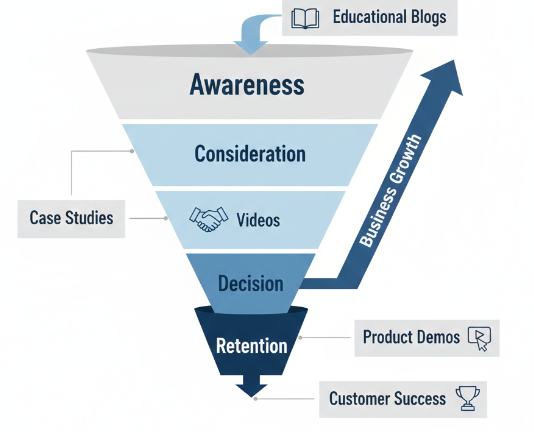
Every piece of content should have a clear purpose. Some content is meant to attract attention, while other content educates or persuades. Mapping content to the buyer journey ensures that no stage is ignored.
At the awareness stage, content focuses on problems and challenges. During consideration, it explains solutions and approaches. At the decision stage, it highlights benefits, proof, and outcomes. This structured approach improves conversions and supports business growth.
Messaging Framework and Brand Voice
Consistency is critical for building trust. A messaging framework defines how a brand communicates its values, tone, and unique perspective. This ensures that all content feels connected, even when published across different platforms.
A strong brand voice makes content recognizable and memorable. Over time, this consistency builds authority and strengthens brand positioning.
Types of Content That Support Growth
Different types of content support growth in different ways. A balanced strategy includes multiple formats to reach audiences at various stages of their journey.
Educational and Long-Form Content
Long-form content such as blog articles, guides, and whitepapers plays a major role in building authority. These resources provide in-depth answers and demonstrate expertise.
Search engines favor comprehensive content that delivers value. As a result, long-form content often attracts steady organic traffic over time. This traffic becomes a reliable source of leads and growth.
Case Studies and Proof-Based Content
Case studies show real-world results. They help potential customers understand how a solution works in practice and what outcomes they can expect.
This type of content builds trust and reduces hesitation. When people see proven success, they feel more confident in making decisions.
Multimedia Content and Engagement Formats
Video, webinars, and podcasts allow businesses to connect with audiences in more personal ways. These formats increase engagement and reach people who prefer visual or audio content.
Multimedia content also supports content re purposing, allowing one idea to reach multiple platforms.
Interactive and Value-Driven Resources
Interactive content such as assessments or tools encourages participation. It provides personalized value and keeps users engaged longer.
These experiences deepen relationships and provide insights into user needs, helping businesses refine their growth strategy.
Content Distribution and Amplification
Creating content is only part of the process. Distribution determines whether content reaches the right people.
Organic distribution through search engine optimization ensures content appears when users search for relevant topics. Email marketing helps nurture relationships by delivering content directly to interested audiences. Social media platforms expand reach and encourage sharing.
In some cases, paid promotion accelerates results. Sponsored content and paid search can help important content reach targeted audiences faster. Strategic partnerships and content syndication further extend reach and credibility.
A strong distribution strategy ensures that valuable content does not remain hidden.
Measuring Content Success for Business Growth
Measurement is essential for understanding what works and what does not. Content performance should be evaluated based on growth objectives.
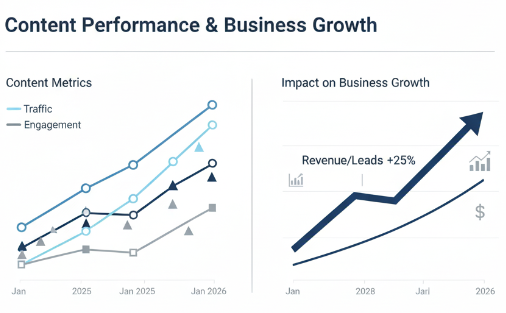
Traffic metrics show visibility and reach. Engagement metrics reveal how audiences interact with content. Conversion metrics indicate whether content supports business outcomes.
Attribution helps identify which content contributes to revenue and lead generation. By analyzing this data, businesses can refine their strategy and invest in high-performing content.
Measurement turns content from a creative effort into a growth system.
Creating a Content Calendar and Workflow
Consistency is a key factor in content success. A content calendar helps businesses plan topics, formats, and publishing schedules in advance.
Clear workflows define roles, timelines, and review processes. This reduces delays and improves quality. When teams know what to create and when, content production becomes efficient and scalable.
A strong workflow ensures that content supports growth continuously rather than sporadically.
Common Challenges in Content Strategy and How to Overcome Them
Many businesses struggle with limited resources, unclear goals, or inconsistent execution. These challenges often lead to frustration and poor results.
The solution lies in prioritization and clarity. Focusing on high-impact content, aligning with clear goals, and using data to guide decisions helps overcome obstacles.
Content strategy is a long-term investment. Businesses that remain patient and consistent see stronger growth over time.
Frequently Asked Questions About Content Strategy for Business Growth
How long does it take for content strategy to show results?
Content strategy is a long-term approach. While some results may appear within a few months, meaningful growth usually takes six to twelve months depending on competition, consistency, and quality.
What type of content drives the most growth?
The most effective content depends on the audience and business goals. Educational and problem-solving content often drives long-term growth, while proof-based content supports conversions.
Can small businesses benefit from content strategy?
Yes. Content strategy is especially valuable for small businesses because it builds visibility and trust without relying solely on paid advertising.
Is content strategy still effective with AI-generated content?
Yes, when guided by human insight and strategy. AI can support efficiency, but value-driven, audience-focused content remains essential.
Conclusion Building a Sustainable Content Strategy for Growth
Content strategies that support business growth are built on clarity, consistency, and value. When content is aligned with audience needs and business goals, it becomes a powerful growth engine.
Businesses that invest in strategic content gain visibility, trust, and long-term relationships. Over time, this leads to stronger brand authority, higher conversions, and sustainable growth.
A successful content strategy is not about publishing more. It is about publishing with purpose.