


Building an effective strategic business plan is not about filling out templates or producing lengthy documents, it’s about creating a clear roadmap that drives sustainable growth, profitability, and long-term success.
Many businesses struggle or fail not because they lack ambition or talent, but because they operate without a clear strategy. Without strategic direction, teams become reactive, resources are misallocated, and decision-making becomes inconsistent. A well-structured strategic business plan solves this by aligning vision, goals, execution, and measurement into a single, actionable framework.
At its core, strategic business planning helps leaders answer three critical questions:
- Where is the business today?
- Where does it need to go?
- How will it get there efficiently and competitively?
As a strategic business consultant, James Akpo helps organizations transform ideas into executable strategies, ensuring that planning leads to real-world results not just theoretical plans. Whether you’re launching a startup or scaling an established business, a strong strategic plan becomes the foundation for confident leadership and informed growth decisions.
What Is a Strategic Business Plan?
A strategic business plan is a long-term, high-level blueprint that defines a company’s direction, priorities, and competitive positioning. Unlike basic business plans that focus mainly on operations or funding, a strategic business plan connects vision, market opportunity, value creation, and execution into one cohesive strategy.
Effective strategic planning blends:
- Process-driven strategy development (as seen in structured planning frameworks)
- Formal business fundamentals such as market analysis and financial clarity
- Value-based decision-making focused on customers, employees, and long-term advantage
A strategic business plan is not static. It evolves as markets change, technology advances, and new opportunities emerge. When done correctly, it becomes a living management tool that guides leadership decisions, resource allocation, and performance measurement.
Strategic Plan vs. Business Plan Key Differences
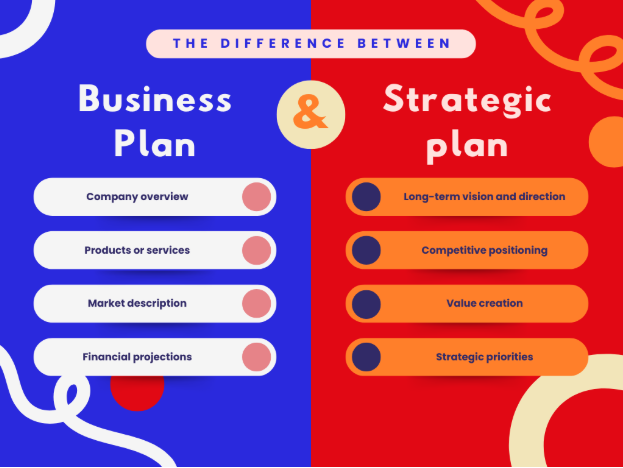
Although often confused, a strategic plan and a traditional business plan serve very different purposes.
A business plan typically focuses on:
- Company overview
- Products or services
- Market description
- Financial projections
- Funding requirements
It is often used for startup validation or investor presentations.
A strategic plan, on the other hand, focuses on:
- Long-term vision and direction
- Competitive positioning
- Value creation
- Strategic priorities
- Execution frameworks and KPIs
In simple terms:
- A business plan explains what the business is
- A strategic plan defines where the business is going and how it will win
High-growth organizations treat strategic planning as an ongoing leadership discipline, not a one-time document.
Why Strategic Business Planning Is Critical for Business Growth
Strategic business planning replaces guesswork with clarity and reactive decisions with intentional action. Businesses that plan strategically are better equipped to adapt, compete, and scale.
Key benefits include:
- Clarity of direction Everyone understands priorities and goals
- Organizational alignment Teams work toward shared outcomes
- Competitive advantage Clear differentiation in the marketplace
- Risk reduction Decisions based on data and insight
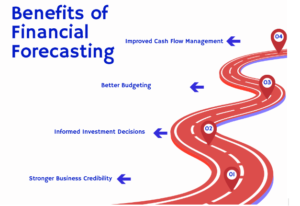
- Financial forecasting Better control over revenue, costs, and investments
- Scalability Structured growth without operational chaos
For leaders, strategic planning builds confidence. For organizations, it creates focus. For stakeholders, it delivers trust and predictability.
Benefits for Startups
For startups, a strategic business plan acts as both a validation tool and a growth safeguard.
Strategic planning helps startups:
- Clarify their value proposition
- Identify viable market opportunities
- Avoid costly trial-and-error decisions
- Prepare for investor discussions with confidence
- Align early teams around clear objectives
Instead of chasing every opportunity, startups with a strategic plan focus on what truly drives progress, increasing their chances of long-term success.
Benefits for Growing & Established Businesses
For growing and established businesses, strategic planning shifts the focus from survival to optimization and expansion.
A well-defined strategy enables organizations to:
- Improve operational efficiency
- Support digital transformation initiatives
- Optimize processes and resource allocation
- Strengthen competitive positioning
- Increase profitability and scalability
Through structured planning and execution support, James Akpo helps organizations turn complexity into clarity, ensuring growth is intentional, measurable, and sustainable.
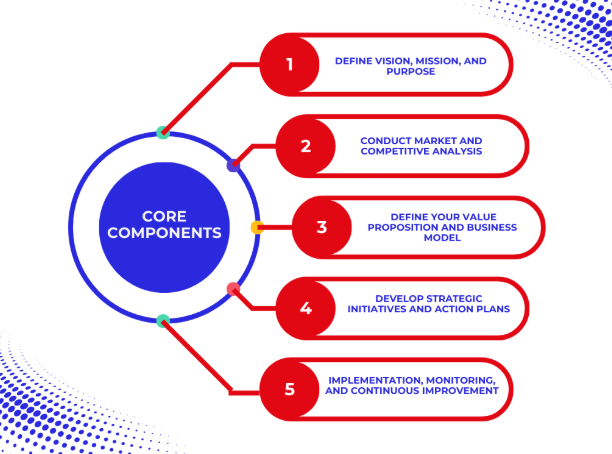
Core Components of an Effective Strategic Business Plan
An effective strategic business plan is built on a clear, repeatable framework one that connects vision to execution and strategy to measurable outcomes.
At a high level, a strong strategic business plan includes:
- A clearly defined purpose and long-term direction
- A deep understanding of the market and competitive landscape
- A compelling value proposition
- Actionable strategic initiatives
- Measurable performance indicators
- A system for review, adaptation, and growth
This framework ensures that strategy is not just documented, but implemented, monitored, and refined over time.